|
| Red-necked grebe |
 |
| Tree Swallow |
 |
| Lincoln’s Sparrow |
New birds today: Golden-crowned Sparrow, Northern Pintail, Gray-cheeked Thrush, Lincoln’s Sparrow, Green-winged Teal, Gadwall, Arctic Tern
|
| Red-necked grebe |
|
| Tree Swallow |
|
| Lincoln’s Sparrow |
New birds today: Golden-crowned Sparrow, Northern Pintail, Gray-cheeked Thrush, Lincoln’s Sparrow, Green-winged Teal, Gadwall, Arctic Tern
I’m short on internet time (which has been wonderful!), so I’m mostly just going to post my journal pages and photos here. To read my musings on the journal pages, click on the photos of the pages to make them bigger.


 |
| Doesn’t this look like two heads? Be careful how long you sit in a rain forest. |
 |
| Moss EVERYWHERE |
 |
| Pretty lichen |
 |
| Cool Spanish Moss-like stuff |
 |
| Harbor Seal |
New birds today: American Pipt, Marbeled Murrelet, Harlequin Duck
Today was incredible. We had scheduled a boat tour for today, hoping we’d have decent weather and worried that I would be seasick. We ended up with what several people said was the best day of the year– sunny all day, warm (relatively speaking), and very calm seas. The ranger on the boat who was guiding and narrating said they might get one such day a year, especially with all the wildlife we saw. I’m just going to post my sketchbook/journal pages describing the day. I painted a couple of these pages while on the boat and the others later.
(Click the pictures to see them large enough to read the writing)


 |
| Holgate Glacier |
 |
| Mountain Goat nursing her kid |
 |
| Bear Glacier |

 |
| Stellar Sea Lions |
 |
| Snow and ice covered island in Prince William Sound |

New birds today: Glaucous-winged Gull, Black-legged Kittiwake, Common Murre, Pelagic Cormorant, Horned Puffin, Tufted Puffin
Snowshoes would have been good today, as would poles, crampons, and probably some other equipment. We tried to hike up to the Harding Ice Fields, but only made it about a quarter of the way up, due to the steep slopes deeply blanketed with snow. At the point we decided to turn back, the trail was doing switchbacks on a mountainside meadow, which would have made the most exciting sledding hill I’ve ever sledded. We backed down, carefully jamming the toes of our shoes as deep into the snow as we could. There were holes where people had thrust poles into the snow; the brilliant blue of the snow down those holes was amazing to me.
We finally made it down past the snow and continued downward, waterfalls of snow melt cascading over the trail. Along the way we kept our eyes open for bears; the National Park Service signs at the trailhead warn of both black and grizzly bears. The warnings are most encouraging: If a grizzly bear attacks you, play dead. If it starts to eat you, fight back.

On the hike down, during which we saw no bears, I heard a song a I thought I recognized from my Birding by Ear CD’s– a Wilson’s Warbler. I searched and he appeared– a beautiful male Wilsons’s Warbler– another first for my life list!
We then hiked out to Exit Glacier. See the tiny people at the base of the glacier? They aren’t really tiny; the glacier is immense! It was COLD near the glacier, with the glacial wind air conditioning the entire surroundings.
 |
| Exit Glacier with people at the base |
 |
| Zooming in on a crevasse |
 |
| Stephen and me; Exit Glacier behind us |
We hiked in the Outwash Plain and I painted. While there, we learned from a friendly ranger who passed by that the gray water in the glacial streams in caused by the gray stones, called Graywacke (pronounced “graywacky”) rubbing together, producing “glacial flour,” a very fine dust that makes glacial outwash streams gray. Clear streams are from snow melt. I loved the outwash plain with its open views and gurgling streams.


After hiking we went to dinner in town and, while waiting for our food, I painted the view out the window. Stephen took this photo from outside of me painting with the mountains reflected in the window. I especially like that he is also in the reflection.


On our way back to our cabin we passed Harbor Seals swimming in the bay beside the road.

We walked to a pebbly beach before we went to bed and saw my first Violet-green Swallows. While I was studying them through my binoculars, a small flash of sunset pinkish, orange-red shot through my field of view– my first Rufous Hummingbird, a fitting color with which to close my day, since I won’t be awake for the sunset after 11:00 tonight.
New birds today: Rufous Hummingbird, Violet-green Swallow, Wilson’s Warbler, Northwestern Crow
Snowshoes would have been nice today. We hiked the Byron Glacier Trail today, which, according to our hike book, is a moderate hike with generally good conditions. Is four to five feet of snow on the trail “good conditions” in Alaska?
There were a two sections of the trail with no snow– sections about five yards long. The remainder of the trail was deep in snow, which thankfully was fairly firmly packed, so that we only sank in a few inches most of the time. I managed to stay more or less on the surface, but Steve sank through to his hip once. Despite the snow, however, it was a wonderful hike. The blue of the glacier was so BLUE (the photo doesn’t do it justice). The mountains on either side were stunning, and all the more so with a juvenile eagle soaring over them and finally landing somewhere on a mountainside.
 |
| Byron Glacier |
I was fascinated by the creek flowing from the glacier, with its distinctly gray water. When I sat on a rock in the middle of a snowfield to paint, from time to time I heard a loud gurgling sound moving toward me. I think it was water working its way along deep under the snow, then rushing around the base of my rock.
 |
| Me painting Byron Glacier |

After hiking to Byron Glacier and also stopping for a walk at the Moose Flats Day Use Area (where I identified my first Orange-crowned Warbler), we drove to Hope and hiked along the Gull Rock Trail in the lush green of ferns and trees for a while. There we saw our first Varied Thrushes– a male and female. What gorgeous birds! We kept hearing Varied Thrushes throughout that hike.
 |
| Stephen on the Gull Rock Trail |
At one point in our drive south from Anchorage I saw a Loon and pulled off to look more closely. While there we also saw a pair of American Wigeons and then a beautiful pair of Barrow’s Goldeneyes– another first for me.
 |
| American Wigeon (male) |
 |
| Barrow’s Goldeneye (male) |
Now, after driving along a road sandwiched between the side of a mountain on one side and Resurrection Bay on the other we are settled for the night in a tiny cabin on Lowell’s Point, our heads filled with images of birds, mountains, and snow covered peaks.
New birds for my life list today: Barrow’s Goldeye, Mew Gull, Orange-crowned Warbler, Varied Thrush, Red-necked Grebe
 |
| Watercolor of the view out my window |
Then we started to cross over the Rocky Mountains, and I read less of my book and did more watching out the window. Why were the mountains more covered with snow on on side? Why were some areas dry and brown while others were richly green? I want to read more about the intersection of geography, weather, and climate.
And then, finally, we were over Northwest Canada and ALASKA. I have never seen such mountains — jagged, huge, increasingly covered with snow as we traveled northward, brilliant in the sun, seemingly endless in all directions. I saw my first glaciers and marveled at the flow lines so clearly visible from above. We passed over avalanches (not happening, but the obvious patterns left by them), and myriad mountains just barely peeking out above snow-filled valleys, then broad valleys of deep green with rivers winding through them, followed by more snow-covered mountains.
 |
| Alaskan mountains from airplane window |
 |
| Avalanche at left center |
In a couple of the valleys we passed over small towns, isolated by distance, geography, and weather. What must it be like to live so far from the society as I know it? There was no sign of people throughout most of the vastness of the mountains— just rugged landscape, mountains in every direction, and more snow than I have ever seen. My kindle forgotten, I spent the last hours of our flight engrossed in the book of God’s creation, brought to tears and filled with awe by such wonder and beauty as I have never seen before.
I walked along the power lines, head craned skyward, trying to sort out at least one clear bird song from the music filling the air. It was impossible; all the songs of many species, and several members of many of those species, mingled and combined to form one continuous stream of notes and calls. And yet, my friend Barbara was naming birds right and left, and ahead, and overhead. How did she do it?
That was me a month ago, even though I had been listening to my bird song CD’s for weeks (and off and on for years). I loved the chorus of mingled song, but it was frustrating not to be able to identify the singers. But then one evening a couple of weeks ago when I was out walking with Stephen and Arielle, I began hearing individual birds… and sometimes even recognizing their songs! It was as though I had been immersed in an unknown language for long enough and finally the sounds were beginning to make sense and have meaning.
I heard a Black-throated Green warbler back in the tall Vermont spruces, then a Hermit Thrush in the shrubs on the other side of the road. I was unable to spot the Warbler because of the thick trees, but it was especially satisfying to enjoy his song, knowing who was singing. We did see the Hermit Thrush, peering at us through low branches and we saw many Red-winged Blackbirds. I heard then spotted a pair of Bluebirds flying overhead. In between happy family conversation, I found I was able to pick out many of the songs I was hearing.
I went to bed happily thinking of birds and awoke early realizing a Brown Thrasher was singing outside our window. It was so cool to wake up naming a bird that I was hearing in my sleep. I don’t hear or see Brown Thrashers around my house, so it was a treat to hear this one singing from the top of a nearby treeearly in the morning and for most of the day.
I still can’t hear or name the birds nearly as well as Barbara can, but I now know it is possible to learn this musical language. I will be listening to my Birding By Ear and More Birding By Ear CD’s eagerly, with more confidence now that I can assimilate these songs into my vocabulary.
 |
| Brown Thrasher opening the day with song |
A Three Dog Life, by Abigail Thomas, was recently recommended to me by someone I hadn’t even met yet, who was so sure I would like it after we’d spoken for five minutes that she mailed me a copy. She was right– I started reading as soon as I tore open the package the book came in, sat down in my rocking chair without even bothering to make tea first (anyone who knows me and my tea habit knows how rarely that happens), and could scarcely put the book down.
A Three Dog Life is a journey with Thomas after her husband’s terrible accident that resulted in serious brain injury. As with most journeys, much that is meaningful happens in ordinary, daily life– eating, knitting, walking, shopping– and Thomas’ real-life description drew me in and made me feel like I could easily sit down and join her for tea with her dogs sprawled around the room. Her three dogs, Harry, Rosie, and Carolina, provide a constant touchstone with the present and source of comfort and companionship, much as my three dogs do for me, and as dogs do for many people in all sorts of circumstances.
Like most people’s journeys, Thomas’ is not smooth and constant– events and thoughts ramble and sometimes jump from present to past and back again in a way that can be momentarily confusing– as life often is for any of us and as it certainly was for Thomas’ husband Rich, and so for her as well. I could relate to these back and forth thoughts, as my mind often leaps capriciously in time based on the slimmest of associations. I really enjoyed meeting another mind that meanders as mine does, weaving present events, memories, and philosophical musings into a tapestry of darks and lights and all shades in between.
Throughout the engaging ramblings of five years of life, this is very much a story of abiding love, with honest reflection on the challenges that went along with that love. Love that endured when all expectations screeched to a halt in one horrible moment that forever changed the whole face of their relationship. Love that persisted through grief and guilt feelings and uncertainty and loss. It is also an inspiring example of finding meaning and joy in life after personal disaster strikes terribly close to home. I am inclined to start right over and read this book again; it is too rich with real life to only read once.

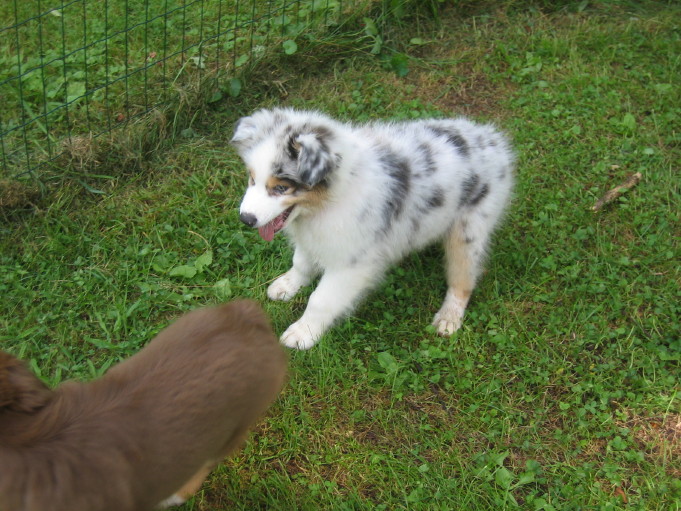
We started out the day as we do most days, with Petra snuggling on my lap while I read and had my morning tea. Then the games began; Petra has her friends Roark and Tallulah visiting for her birthday, so today is full of Aussie fun.
 |
| Rowan, Roark, Tallulah, Petra (back to front) |
Petra does everything fast, so birthday fun for her means running (almost too fast to be seen)…
(If you click the photos, you can see them bigger.)


and playing chase…


and leaping in the air…

That was a fun party with friends!
 |
| Tallulah, Petra, Roark, Rowan |

Happy Birthday, Petra Sweetie! You bring me joy and love every day, and I adore you.

I still smile every time I think of the Trumpeter Swans I saw in Ohio last month. They were an unexpected treat, since I had no idea there were Trumpeters anywhere in the East. When I first saw them, I thought they must be Tundra Swans, which look very similar, because my bird book (Peterson’s Field Guide to Birds East of the Rockies, fourth edition) doesn’t even include Trumpeter Swans.
As I wandered the boardwalks in the area, I wondered what the loud, honking noise was that I heard echoing frequently over the marshes– Trumpeter Swans! These birds float gracefully and serenely in the marshes, dipping their long necks under to eat plant material and staining their heads and necks red with the ferrous minerals in the sediment.

Trumpeter Swans used to be native to that area, but were extirpated by over-hunting and loss of habitat in the 1800’s. In 1996 they were reintroduced to Ohio and now there is a breeding population of these majestic birds.
Trumpeter Swans are the largest North American waterfowl (20-30 pounds) with a wingspan of 6-8 feet and they can fly between 40 and 80 miles per hour. They mate for life and usually live about 15-20 years in the wild. They mate for life and build large nests, up to 6 feet in diameter, in marshes, and tend to reuse the same nest year after year.
 |
| I don’t know if this is a Trumpeter Swan nest, but it was very large with large eggs, so I think it might be |


Links for more info:
Trumpeter Swans in Ohio
The Trumpeter Swan